







BY – Blessing Jonathan/Oluwafunmilayo Ogedengbe
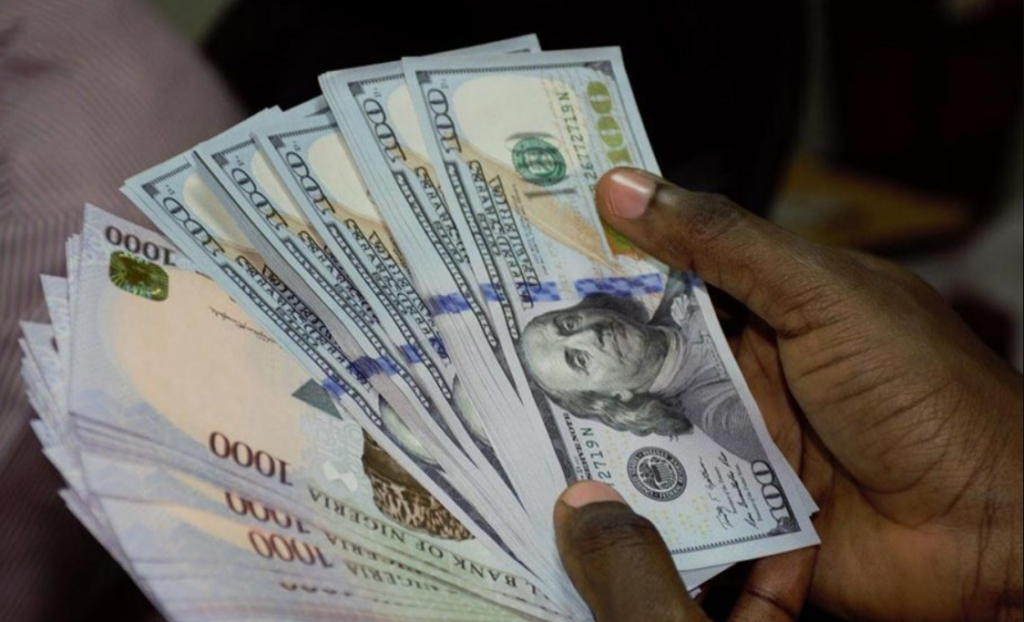
The Nigerian parallel market witnessed a substantial increase in the Dollar-Naira exchange rate, reaching an alarming N930/$1 on Thursday, August 10, 2023.
This surge is attributed to heightened demand for the dollar by importers and other users, surpassing the available supply. Contributing factors include the absence of price controls and the Central Bank of Nigeria’s (CBN) inability to intervene effectively.
Marketers are expressing frustration as the dollar’s price continues to rise significantly on a daily basis. Just the previous day, the dollar was sold at N910, marking a N20 increase within 24 hours. Currency traders explain that presently, they buy at N920/$1 and sell at N930/$1, leaving a profit margin of at least N10.
There is growing apprehension among Nigerians that fuel prices might also escalate soon, even though the Nigerian National Petroleum Corporation Limited (NNPCL) has not indicated any immediate changes.
NNPCL previously informed the public that while fuel subsidies remain removed, petrol prices will be influenced by the dollar exchange rate. This information fuels concerns that the current price of N600 per litre may rise in response to the current N930/$1 exchange rate.
Furthermore, the recent increase in crude oil prices, reaching approximately $87 per barrel, is likely to impact fuel prices in the near future if stability isn’t achieved.
“The crash of the naira against the dollar and the recent rise in crude oil price is making one apprehensive when you consider the effect on petrol price in Nigeria. Fuel price is likely going to rise again this month,” warns Collins Nnabue, a resident of Abuja.
Some marketers are hopeful that the president will step in to address the situation.
Financial reports indicate that in July 2023, the Naira’s exchange rate depreciated by 11.5%, and by early August, it had further dropped by 18.7%.
Further analysis reveals that the scarcity of dollars is due to forex traders hoarding them and waiting for higher bids before selling. This has resulted in a limited circulation of dollars.
Traders are compelled to purchase dollars on the parallel market due to the rising prices, as the scarcity has also affected commercial banks, which are unable to offer more favorable rates.
An anonymous trader explains, “The problem is that there is scarcity of foreign exchange and the demand is very high. Commercial banks are not really getting allocation from the CBN and do not have foreign exchange and so most importers and other end users go to the black market to source their foreign exchange.
The high exchange rate is due to low supply as most people with the dollars are not selling and most of the supplies are from diaspora remittances from individuals who sell their forex at whatever rate they like.’’
Alhaji Aminu Gwadebe, President of the Association of Bureau De Change Operators of Nigeria (ABCON), recently called for a ban on Binance, a cryptocurrency platform that he believes influences exchange rates, exacerbating the situation.
“If you know about Binance, you will know that Binance trading is becoming the anchorage of both the investors and exporters window and the parallel market, which is unfortunate.
“So, we have to do something that can stop Binance. It’s a competition; we need to ban Binance and the only way to do so is if you have liquidity.
“As I speak, Binance is the most liquid market; they do 1.2 million transactions per second. So it’s a very liquid market but that is not a scary status, we can break it through our local content and peculiarities,” Gwadebe said in a recent interview.
Billy-Gillis Harry, President of the Petroleum Products Retail Outlets Owners Association of Nigeria (PPROOAN), urges President Ahmed Tinubu to urgently address refinery repairs to prevent further escalation of fuel prices.
“So long as the naira is losing against the dollar, the price of petrol in our retail outlets will continue to increase.
“We have requested that the President should declare a state of emergency on our refineries in order to speed up their repairs.
“That is the one sure way to go, in order to be able to predict the price of petroleum products, because for now, every PMS you buy in any retail outlet is dollarised,” Harry said.
Chinedu Okonkwo, National President of the Independent Petroleum Marketers Association of Nigeria (IPMAN), adds that the cost of PMS will continue to fluctuate as long as the oil sector remains deregulated.
“When there is deregulation and no subsidy, the price of petrol would either go up or come down. But if you want to profiteer, those who bring in and sell at cheaper rates would put you out of business,” Okonkwo said.
“When there is deregulation and no subsidy, the price of petrol will either rise or fall. However, if you want to profit, competitors selling at lower rates will impact your business.”
In the midst of these concerns, there is a promise of potential intervention by President Tinubu if the situation worsens.
IPMAN Comptroller General, Mike Osatuyi, confirms, “First of all, we must thank President Tinubu for removing fuel subsidies because the country would have been in big burden by now.
“In view of the rising prices of crude oil, we can now see that the quantity of petrol they said we used to consume had dropped. At the same time, we can see that price of crude oil is increasing, meaning; Nigeria would have more money in addition to the money the country has saved from subsidy removal. Then, since we have more money in the country, we have pay as petrol price keeps rising.”
“Ex-depot price is now between N585 and N590 per litre depending on the depot, and it will either go up or come down, depending on crude price and exchange rate.
“But the president has said that there would be interventions if need be. So, we believe they are watching as the situation arises.”
Opinion:
In a concerning development, the Nigerian Naira has edged closer to the N1000/$1 threshold at the parallel market. Economic experts attribute this worrying trend to a combination of factors, including inflationary pressures, dwindling foreign reserves, and an uncertain economic outlook.
The Central Bank of Nigeria (CBN) is closely monitoring the situation and is expected to take measures to stabilize the currency’s value. Citizens and businesses alike are feeling the impact as the exchange rate volatility raises concerns about the cost of imports and overall economic stability.
One of the most concerning issues has been its steady decline in value against major foreign currencies, particularly the United States Dollar (USD). In recent months, the Naira has been struggling to maintain its stability, and alarmingly, it is now approaching the critical threshold of N1000/$1 at the parallel market. This essay aims to shed light on the factors contributing to this situation, its consequences on the Nigerian economy, and potential measures to address the issue.
Factors Contributing to the Weakening Naira:
1. External Factors:
The Naira’s depreciation is partially influenced by external factors such as global economic conditions, fluctuations in oil prices, and the impact of the COVID-19 pandemic. Nigeria heavily relies on oil exports, and any decline in oil prices significantly affects the country’s foreign exchange reserves, making it difficult to support the Naira’s value.
2. Trade Imbalance:
Nigeria has been grappling with a persistent trade imbalance for years. The country imports more goods and services than it exports, resulting in a constant outflow of foreign currency. This trade deficit puts pressure on the Naira’s value, as demand for foreign currency surpasses its supply.
3. Inflation and Monetary Policies:
Persistent inflation erodes the purchasing power of the Naira and negatively impacts its value. The Central Bank of Nigeria (CBN) plays a crucial role in managing inflation through its monetary policies. However, the effectiveness of these policies has been a subject of debate, as the CBN implements measures that often lead to multiple exchange rates and a disparity between official and parallel market rates.
Consequences of a Weaker Naira:
1. Rising Cost of Living:
A weaker Naira significantly impacts the cost of living for ordinary Nigerians. As the value of the currency declines, the prices of imported goods, including essential commodities, rise. This inflationary pressure reduces the purchasing power of citizens, making it harder for them to afford basic necessities.
2. Reduced Foreign Investment:
A devalued currency deters foreign investors from entering the Nigerian market. It creates uncertainty, as investors are concerned about potential losses due to currency depreciation. Reduced foreign investment limits economic growth, job creation, and the overall development of the country.
3. Capital Flight:
When the value of the Naira weakens, it incentivizes individuals and businesses to convert their holdings into more stable foreign currencies. This capital flight further depletes Nigeria’s foreign exchange reserves and puts additional pressure on the Naira’s value.
Addressing the Issue:
1. Diversification of the Economy: Reducing the country’s heavy reliance on oil exports is crucial for long-term economic stability. Encouraging investment in non-oil sectors such as agriculture, manufacturing, and technology can help create jobs, boost exports, and reduce the trade deficit.
2. Attracting Foreign Investment: Establishing an environment conducive to foreign direct investment (FDI) can attract essential foreign exchange. This necessitates improvements in infrastructure, streamlining business operations, and offering incentives to attract investors.
3. Strengthening Institutions: Improving the efficiency and transparency of institutions responsible for fiscal and monetary policies is essential. This includes enhancing the CBN’s management of monetary policy, ensuring effective regulation and supervision of the financial sector, and combating corruption.
4. Sustaining Monetary Policy Consistency: The pivotal role of the Central Bank of Nigeria (CBN) in exchange rate management cannot be understated. The implementation of a reliable and credible monetary policy can instill investor confidence in the Naira. This encompasses managing the money supply, interest rates, and inflation.
5. Promoting Export-Oriented Industries: Encouraging the growth of export-oriented industries can help increase foreign exchange earnings. Providing incentives and support to agricultural producers, manufacturers, and service providers can enhance their competitiveness in international markets.
6. Enhancing Trade Equilibrium: Advocating for policies that ameliorate the nation’s trade balance is essential. This could involve reducing unwarranted imports and incentivizing local industries to amplify exports.
7. Elevating Transparency and Governance: Augmenting transparency in the oversight of foreign exchange reserves and funds is pivotal. Effective anti-corruption initiatives can heighten investor trust and draw foreign investments.
8. Exercising Fiscal Prudence: Upholding fiscal discipline is vital in curbing excessive government spending and budget shortfalls. Heightened government borrowing can strain the Naira.
9. Instituting Economic Restructuring: Initiating structural reforms that tackle root economic issues, such as infrastructural deficits, inefficient public enterprises, and regulatory obstacles, can drive stability.
10. Promoting Education and Awareness: Enlightening the public on the significance of a steady exchange rate and its implications for the economy can aid in managing expectations and mitigating panic-driven responses.
11. Fostering Collaborative Endeavors: Engaging a spectrum of stakeholders, encompassing the private sector, financial institutions, and international collaborators, in the development and execution of strategies to stabilize the Naira is vital.
It is essential to underscore that addressing exchange rate challenges involves intricate and long-term endeavors. Each step presents trade-offs and obstacles, underscoring the necessity for a comprehensive and integrated strategy to attain enduring stability.

