







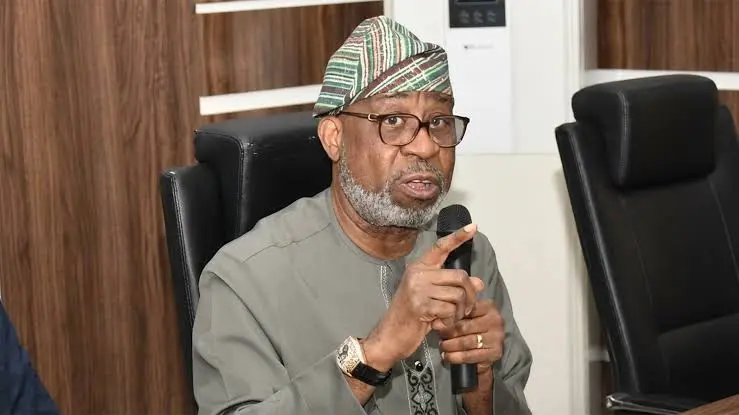
The Federal Government has recorded a major breakthrough in its solid minerals sector following the discovery of a world-class polymetallic mineral province in Kaduna State containing platinum group metals, gold, nickel, copper, lithium and rare earth elements.
The Minister of Solid Minerals Development, Dele Alake, announced this on Wednesday at the opening ceremony of the African Natural Resources and Energy Investment Summit 2026 held in Abuja under the theme, ‘One Africa, One Resource Vision’.
He described the discovery as one of the most significant developments in Nigeria’s mining industry in recent years, saying it was verified by the Nigerian Geological Survey Agency (NGSA) and could significantly strengthen the country’s position in the global race for critical minerals.
The minister explained that the discovery was made by a private company working in collaboration with the agency.
According to him, the new mineral province contained exceptionally high-grade deposits of strategic minerals that are increasingly sought after globally for clean energy technologies and advanced manufacturing.
“Recently, and this is very, very important for newsmen and stakeholders to take note, this is the first time I am announcing this publicly. Recent exploration breakthroughs verified by our Nigerian Geological Survey Agency have unveiled a world-class polymetallic mineral province in Kaduna State, consisting of world-class platinum group metals, precious and critical mineral deposits.
“The province is notable for significant deposits of gold, nickel, copper, lithium and rare earth elements of exceptionally high grades, positioning Nigeria among the emerging destinations for strategic mineral resources and sustainable mining investment.
“This is a new discovery by a private company assisted by our agency, the Nigerian Geological Survey Agency,” Alake stated.
The announcement came as Alake highlighted sweeping reforms being implemented by the Federal Government to reposition mining as a major contributor to economic growth and industrialisation.
He disclosed that the administration of President Bola Tinubu has identified the solid minerals sector as a strategic pillar of its economic diversification agenda, with policies deliberately designed to attract investment, encourage local processing and boost government revenues.
The minister said Nigeria was gradually abandoning the traditional model of exporting raw minerals in favour of domestic beneficiation and value addition.
“For too long, Nigeria’s mineral endowment did not translate into sufficient national value. The paradox was very clear: vast mineral potential but limited beneficiation, rising global demand but inadequate geological confidence, legal authority but weak enforcement, abundant activity but too much informality.
“That is precisely why the reforms we are implementing matter. We have focused on restoring discipline in licensing, strengthening compliance, improving transparency and ensuring that mineral assets are held by operators with the capacity and intention to develop them.
“We have had to revoke over 3,000 dormant and defaulting mineral titles as part of a broader clean-up aimed at discouraging speculation, freeing idle assets and restoring seriousness to licence holding,” he said.
While highlighting that value addition had become a central pillar of the government’s mining policy, Alake continued, “We introduced a requirement that applicants for mining leases must submit detailed value-addition plans. This was deliberate. It sends a clear message that Nigeria will no longer be satisfied with a pit-to-port model in which raw minerals leave the country without leading to domestic transformation.
“We want mining investments that lead to processing plants, refineries, industrial clusters, local jobs, technology transfer and stronger linkages with the wider economy. We want to retain more value within Nigeria through processing, jobs, technology and manufacturing.”
The minister said the policy was already yielding tangible results, citing a wave of investments in lithium processing and mineral refining facilities across the country.
According to him, investors have committed billions of dollars to processing projects that are expected to alter the structure of Nigeria’s economy.
“This sector has witnessed growing interest in local processing projects, particularly in lithium and other strategic minerals. There is an $800m processing project investment in lithium. We have another $600m investment in a lithium processing factory in Nasarawa State.
“There is also a $200m lithium factory near Abuja that has been completed and is awaiting commissioning. We are currently looking at our calendar so that we can commission it. Another company has completed a $50m lithium factory in the Federal Capital Territory and is already adding a second layer of lithium refining.
“As we speak today, all kinds of lithium factories, gold refineries and processing facilities for other precious minerals are springing up across Nigeria solely because of the effectiveness of our local value-addition policy.
“There is also a $1bn iron ore-to-steel project in Kogi State. These are the types of midstream and downstream investments that begin to change the structure of an economy,” he added.
Alake further disclosed that government revenues from the mining sector had grown substantially since the reforms commenced.
He said revenue increased from about N6bn before the current administration took office to over N38bn in 2024 before crossing N70bn at the end of 2025.
“Our revenue performance has improved significantly. When this administration came into office, the sector generated roughly N6bn. A year later, we generated over N38bn and by the close of 2025 we had crossed the N70bn mark.
“You can see the geometric progression in revenue inflows from a sector that was generating barely N6bn before these reforms and before the creative re-engineering of the solid minerals sector,” he said.

