







As political activities gradually gather momentum ahead of future electoral contest, renewed attention is being directed toward certain provisions of Nigeria’s Electoral Act that many citizens believe remain poorly understood.
The debate was recently reignited after excerpts of key sections of the law began circulating widely on social media platforms, prompting discussions among legal experts, political observers, and ordinary Nigerians.
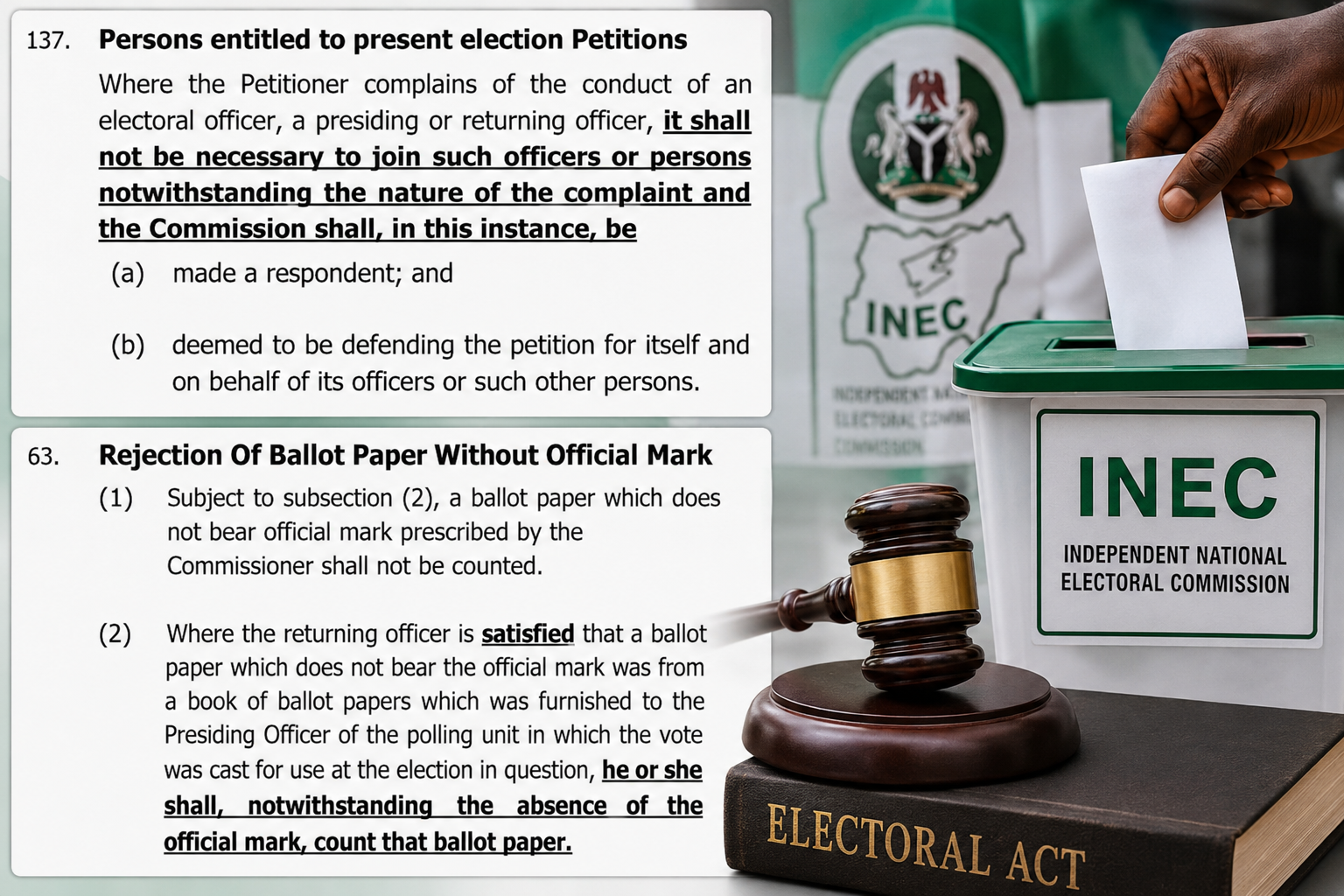
At the center of the conversation are provisions dealing with election petitions and the treatment of ballot papers that may not bear official marks. While these sections have existed within the law for some time, their recent circulation has encouraged fresh scrutiny of how election disputes are handled and how votes are counted during electoral processes.
One of the highlighted provisions relates to the conduct of electoral officers during elections. The section explains that where a petitioner complains about the actions of a presiding officer, returning officer, or another electoral official, it is not necessary for the petitioner to include those officers as individual respondents in an election petition. Instead, the electoral commission becomes the respondent and is regarded as defending both itself and its officials.
Legal analysts say this provision was designed to simplify election litigation and prevent petitioners from facing unnecessary procedural hurdles. Election petitions often involve allegations concerning the conduct of numerous officials across multiple polling units. Requiring each officer to be individually joined as a respondent could significantly complicate legal proceedings and prolong the resolution of disputes.
According to observers, the law recognizes that electoral officers act on behalf of the electoral commission while carrying out their duties. As a result, the commission assumes responsibility for defending actions taken by its personnel in the course of conducting elections.
Supporters of the provision argue that it promotes efficiency and ensures that election petitions focus on substantive issues rather than technical procedures. They contend that petitioners should be allowed to challenge electoral conduct without being burdened by the task of identifying and serving every official involved in a disputed election.
However, some commentators believe that the provision also places a significant responsibility on the electoral commission to maintain high standards among its personnel. Since the commission may ultimately be called upon to defend the conduct of its officials, it must ensure that officers are adequately trained and adhere strictly to electoral guidelines.
The second provision attracting widespread attention concerns ballot papers that do not bear an official mark. Under the Electoral Act, a ballot paper lacking the prescribed official mark is generally not to be counted. This rule is intended to protect the integrity of elections by preventing the inclusion of unauthorized or fraudulent ballot papers in the counting process.
Yet the law also provides an important exception. If the returning officer is satisfied that a ballot paper originated from the official ballot papers supplied for use at the polling unit where the vote was cast, the ballot may still be counted despite the absence of the official mark.
This exception has become a focal point of debate among election stakeholders. Some individuals interpret the provision as evidence that a missing official mark does not automatically invalidate a vote. Others argue that the exception should be applied cautiously and only where there is clear evidence that the ballot paper is genuine.
Election experts note that the purpose of the provision is to protect voters from losing their votes because of administrative errors beyond their control. In situations where election officials inadvertently fail to apply an official mark, voters who complied with all voting requirements should not necessarily be disenfranchised.
The provision seeks to strike a balance between safeguarding electoral integrity and protecting the democratic rights of citizens. While election authorities must guard against fraud, they must also ensure that legitimate votes are not discarded unnecessarily.
Political observers say the recent online discussions reflect a growing public interest in electoral laws and democratic processes. More Nigerians are taking the time to read legal provisions and examine how elections are governed. This increased awareness is viewed by many as a positive development for democratic participation and accountability.
Nevertheless, experts caution against drawing broad conclusions from isolated sections of the law without considering the wider legal framework. Electoral disputes are often complex and involve multiple provisions, judicial precedents, regulations, and factual circumstances that must be evaluated together.
Courts hearing election petitions generally consider not only what the law says but also the evidence presented before them. The interpretation of any particular provision may depend on the specific facts of a case, the nature of the allegations, and the impact of any irregularities on the overall outcome of an election.
Legal practitioners emphasize that election law is one of the most specialized areas of jurisprudence because of the strict timelines and procedural requirements involved. For this reason, isolated readings of individual sections may not always provide a complete picture of how courts are likely to rule on election-related matters.
The renewed interest generated by these provisions highlights the importance of civic education and public understanding of electoral processes. Many observers believe that greater awareness of electoral laws can help citizens participate more effectively in democratic governance while reducing misinformation and confusion.
As discussions continue across various platforms, stakeholders are encouraging Nigerians to rely on accurate legal interpretations and verified information when engaging in debates about elections. They argue that informed public discourse contributes to stronger institutions and a healthier democratic culture.
With future elections always on the horizon, the attention being paid to these sections of the Electoral Act demonstrates the enduring importance of transparency, accountability, and legal clarity in Nigeria’s democratic journey. Whether viewed from a legal, political, or civic perspective, the provisions serve as a reminder that electoral laws play a critical role in shaping public confidence in the electoral system and ensuring that the will of the people is fairly reflected through the ballot box.

