



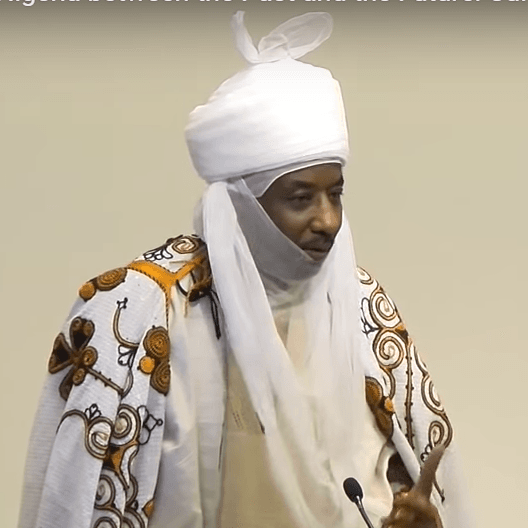
Former central bank governor now Emir of Kano, Muhammadu Sanusi II has countered recent claim by Vice President Kashim Shettima that Aliko Dangote and Rabiu AbdulSamad are Africa’s first and second richest men courtesy of Lagos not Kano – their state of origin.
Speaking at the Institute of Chattered Secretaries and Admnistrators of Nigeria (ICSAN), 60th anniversary celebration, he firmly asserted that Nigeria’s leading industrialists were products of Lagos’ economic environment not Kano’s.
Top Society had reported the Vice President as saying: “it was Lagos that gave Africa its richest man, not Kano. Aliko Dangote is a Lagos man.” He added that Africa’s second richest man, Abdulsamad Rabiu of BUA Group, also emerged from the Lagos business environment.
But speaking at the ICSAN event where the Kano chapter was inaugurated, Sanusi said it was important to “set the record straight” on the origin of Nigeria’s most successful entrepreneurs, insisting that historical facts support Kano’s claim.
According to him, “It is not surprising that the two richest Africans we have are from Kano — Aliko Dangote and Abdulsamad Rabiu.
“I am informed that Lagos is trying to claim that it produced them. We are happy that people are claiming our sons, but just for clarity and for the record, Kano produced them.”
The Emir went further to argue that both business moguls merely expanded their influence through Lagos, stressing: “Kano produced Abdulsamad. And the two of them went to Lagos to teach them how to do business. So I hope that correction is noted. We produced them, they went, they saw, they conquered.”
Beyond the debate over economic origins, Sanusi used the platform to highlight Kano’s historical significance, recalling that the ancient city was once “the third largest city in Africa after Cairo and Fez” and a dominant commercial hub in trans-Saharan trade.
He said Kano’s legacy explains its continued production of influential figures in commerce, adding that the city has long been “the undisputed commercial centre in sub-Saharan Africa.”